
Claude and ChatGPT · setup
Run ClimateFluent's checks inside Claude and ChatGPT
Ask what CBAM will cost your exports, which EcoVadis documents you hold, what a GHG inventory needs, or which GRI disclosures apply. The answer comes back as a card in the chat, with every figure traced to its source.
https://climatefluent.com/mcp
This is the one address both assistants ask for. Setup takes about two minutes.
01 · Claude
Connect in Claude
Custom connectors work on every Claude plan: Free (one custom connector), Pro, Max, Team and Enterprise. Add it on claude.ai or in Claude Desktop and it works in the Claude mobile apps too.
Free, Pro and Max
- Go to Customize, then Connectors.
- Press Add custom connector (on some accounts, + Add first). Name it ClimateFluent and paste the address above as the server URL.
- If Claude asks for authentication settings, keep what it detects: sign-in with OAuth. If it asks how to identify itself, choose Register automatically. Press Add.
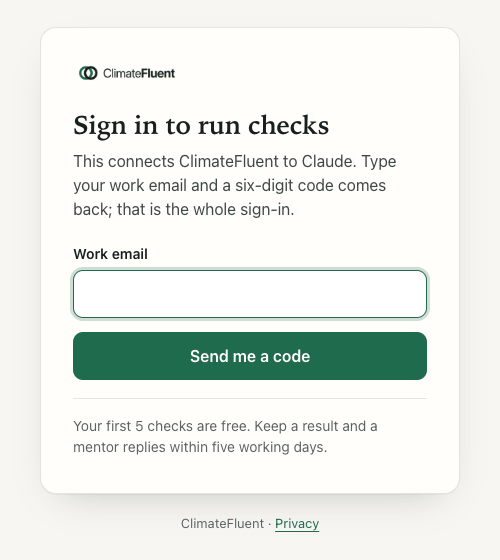
- Claude opens our sign-in page. Type your work email, the same one you use for the workspace, then the six-digit code we email you. The code works for ten minutes.
- In a chat, press +, choose Connectors and switch ClimateFluent on. Ask your question, and when Claude asks to use a ClimateFluent tool or show the card, choose Allow.
Team and Enterprise
- An Owner goes to Organization settings, then Connectors, presses Add, then Custom (choosing Web if asked), pastes the address and presses Add.
- Each member opens Customize, then Connectors, finds ClimateFluent with the Custom label and presses Connect to sign in with their own work email.
Cards appear in Claude chat on the web, in the desktop app and on mobile.
Claude Code
Add the server from your terminal, then run /mcp inside Claude Code and follow the sign-in in your browser. Results come back as text.
claude mcp add --transport http climatefluent https://climatefluent.com/mcp02 · ChatGPT
Connect in ChatGPT
On ChatGPT on the web, with developer mode. When the ClimateFluent listing is live in ChatGPT's directory, connect it from there and sign in as in step 5.
- Open Settings, then Security and login, and turn on Developer mode. On a Business, Enterprise or Edu workspace, an admin turns developer mode on for the workspace first.
- Go to ChatGPT Plugins, press the plus button and choose Add custom MCP server.
- Name it ClimateFluent, add a short description, and paste the address above as the server URL.
- Choose OAuth for authentication, confirm with I understand and want to continue, then press Create as a plugin.
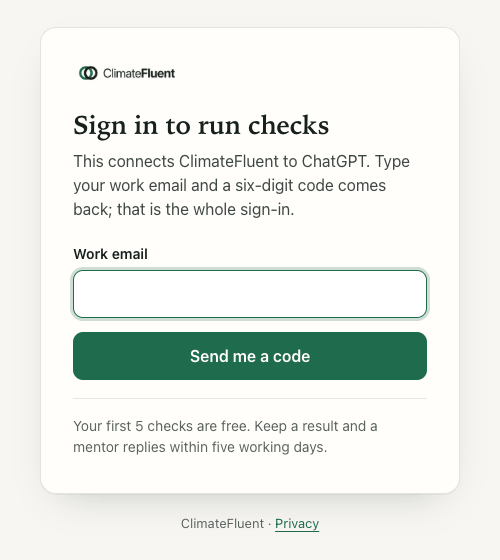
- ChatGPT opens our sign-in page. Type your work email, the same one you use for the workspace, then the six-digit code we email you. The code works for ten minutes.
- In a new chat, type @ in the prompt box, pick ClimateFluent and ask your question.
OpenAI sets which plans use developer mode; their help article under Sources lists them. If a menu label reads differently, look for developer mode under Settings and for the place to add a custom MCP server.
03 · What to ask
Four checks, one question each
CBAM exposure
The cost per tonne and per year for 2026 to 2028 on the default value, and what your EU importer will ask you for.
TryWhat will CBAM cost 1,200 tonnes of stainless bar shipped to Germany?
EcoVadis readiness
The 21 evidence documents, your coverage by theme, and a gap list that names who usually holds each one. Tick documents on the card and the coverage updates.
TryWhich EcoVadis documents does our factory need? We hold a signed environmental policy and a POSH annual report.
Have the questionnaire export? Check your evidence free: the files EcoVadis is likely to turn down, the fix for each, and what to upload first. How the workspace fits together: EcoVadis evidence check docs.
GHG inventory map
Every Scope 1, 2 and 3 source, the data it needs, and the named factor table it draws on, with the grid table for your country.
TryMap a Scope 1, 2 and 3 inventory for our sites in India.
GRI disclosure map
The disclosures your report section needs, by number, with the question an assurance provider asks of each.
TryWhich GRI disclosures do we need for energy, emissions and safety in a 2027 report?
04 · EcoVadis workspace
Prompts for your evidence workspace
Sign in with the email you use for the workspace and the assistant lists what needs work, reads a workspace file against the document rules and adds the fix to your plan. Each prompt names ClimateFluent so the assistant picks the right tool.
Use ClimateFluent to list my EcoVadis projects.
Lists the companies and projects your email can open, with your role.Use ClimateFluent: what needs work in our EcoVadis project? Start with the high-impact themes.
Questions with no document, failing files with the reason, gates to sign, open actions, expiring documents.Use ClimateFluent to read our social audit certificate in the workspace and check it against the document rules. Add the fix to our plan.
Reads the file, checks it against rules R1 to R12, adds the action you agree.Use ClimateFluent: which documents would strengthen LAB3204? We are a large textile exporter in India.
Documents that usually serve, Indian examples, options left unticked in your export.Use ClimateFluent to turn these improvement areas into actions. Show me the mapping before adding anything.
Paste last cycle's improvement areas in your own words after the prompt.How results land in your workspace
- Same email, same workspace. The sign-in in Claude or ChatGPT acts as your workspace account, with the same role.
- Facts, gates and actions are saved to the project. A document recorded, gates confirmed, a review proposed or an action added in the chat shows on the question page and in the plan straight away.
- A reading is a proposal. The assistant's review of a document stores its quotes and pages; you answer the three gates yourself, in the chat or on the question page.
- Files stay in the workspace. Upload files on the question page. In the chat, the assistant reads a workspace file through
ecovadis_read_document.
05 · Reference
What each tool does
Workspace tools appear when your sign-in email belongs to a workspace. The rest work for anyone signed in.
The EcoVadis tools, in plain words
With a workspace
| Tool | In plain words |
|---|---|
| ecovadis_projects | Lists the companies and projects you can open, with your role and counts. The assistant calls it first. |
| ecovadis_issues | What needs work in one project, by theme: questions with no document, files failing a check and why, gates to sign, open actions, previous documents expired or expiring within 90 days. |
| ecovadis_documents | The document register: each file, its kind, pages, and per question the page cited and the gate state. |
| ecovadis_read_document | Opens one workspace file and returns its text to the assistant, 12,000 characters at a time. |
| ecovadis_document_check | Checks the facts of one document against ClimateFluent's document rules R1 to R12 and gives the fix for each rule it fails. |
| ecovadis_suggest_documents | For a question, or for every gap highest impact first: the documents that usually serve, Indian examples, matching policy templates, and what your export left unticked or undocumented. |
| ecovadis_rubric | The checklist for reading one document against up to six question codes at once. |
| ecovadis_review | Records the assistant's reading of that document, with the page and a short quote per item, for you to confirm. |
| ecovadis_add_action | Adds an action you decide on to the plan: what to do, effort, owner and due date. |
| ecovadis_cap_import | Maps improvement areas you paste to question codes and priorities; shows the mapping first and adds the actions when you say so. |
| ecovadis_policy_template | A policy skeleton in our words for the company to adapt, approve, sign and date. |
For anyone signed in
| Tool | In plain words |
|---|---|
| ecovadis_readiness_check | The quick check: 21 evidence documents across the four themes, which you hold, and who in a company usually holds each gap. Shows as a card. |
| ecovadis_start | Starts an assessment for one company; paste the export text to bring in your question codes. |
| ecovadis_guideline | ClimateFluent's guideline for one question code: what it is about, which documents serve, Indian examples, and questions to ask about your document. |
| ecovadis_record_document | Records the facts of a document you shared in the chat and runs the code checks: validity, company name, format, size, page cited. |
| ecovadis_confirm_gates | Stores your Yes or No for the three gates, Relevant, Recent and Ready. |
| ecovadis_plan | The action plan by quadrant of impact and effort, and the questions with no document yet. |
| ecovadis_update_action | Changes an action's effort or owner; in a workspace project it can also take an action off the plan. |
06 · Results
On the card
- Email me this result. The result lands in your inbox, with a copy to our team.
- Open the full check. The CBAM card opens the same check on this site, with more inputs: CBAM exposure check. For EcoVadis, check your evidence free with your questionnaire export.
- The review date. Each card shows when its rules were last reviewed. Figures are gross estimates on published rules, and every factor table is named so you can take the value from the source.
07 · Privacy
Sign-in and your data
- Sign-in is your email and a six-digit code. You do it once, when you connect. Your first checks are free.
- ClimateFluent keeps your sign-in email, when you signed in and how many checks you ran. With a workspace, also what you save there: document facts, gate answers, actions, and quotes of up to 160 characters with their page when the assistant proposes a reading. We keep the text of a result when you press Email me this result.
- The assistant receives the tool results, including a workspace file's text when you ask it to read one. We send that text for that request only and keep no copy. Anthropic and OpenAI handle your conversation under their own policies.
- To see, correct or delete your data, write to hello@climatefluent.com. Full detail: privacy policy, section 8 (ChatGPT and Claude) and section 9 (evidence workspace).
08 · Disconnect
Disconnect
- Claude, one chat: press +, choose Connectors and switch ClimateFluent off.
- Claude, everywhere: go to Customize, then Connectors, and press Remove next to ClimateFluent. On Team and Enterprise, an Owner removes it under Organization settings, then Connectors.
- Claude Code: run
claude mcp remove climatefluent. - ChatGPT: open ChatGPT Plugins, open the ClimateFluent connection and remove it.
Your workspace stays as it is; sign in on the web as before. To connect again, repeat the steps above.
09 · Help
If something looks off
- The answer came back as text, with no card. In Claude, check the connector is switched on in the chat's + menu. If it is, disconnect and reconnect it under Customize, then Connectors.
- The code has not arrived. Look in spam, then press Send a new code on the sign-in page. A code works for ten minutes.
- Anything else. Write to hello@climatefluent.com with the question you asked and what you saw.
Steps checked against Anthropic's and OpenAI's pages on 6 October 2026: custom connectors using remote MCP, adding a connector outside the directory, Claude Code and MCP, developer mode and MCP apps in ChatGPT, connect and test your plugin.
Independent of EcoVadis: ClimateFluent prepares your evidence; EcoVadis does the rating. EcoVadis is a trade mark of EcoVadis SAS.